
With their 1983 debut, the Violent Femmes got the ball rolling for what would become alternative rock, using acoustic instruments to deliver an unexpectedly raw blend of punk angst and catchy-if-neurotic songwriting. The band's subsequent '80s albums were a mixed bag, yielding occasional highlights but not quite gelling into anything as consistently powerful as the first album. Released in 1991, fifth album Why Do Birds Sing? was something of a return to form, if only in terms of having song after song of the kind of weirdly fractured folk pop that represented the band at their most accessible. Upbeat and straightforward album-opener "American Music" is somewhere between campfire song and pop masterpiece, with subtle production details like sleighbells and sparingly used organ runs growing along with the song's steady build. More blatant stabs at pop come with a snarling cover of Culture Club's hit "Do You Really Want to Hurt Me," the inverted girl group appropriation of "Look Like That," and the driving college rock of "Used to Be." The band's penchant for sardonic and juvenile humor remains intact on the faux-blues stomp of "Girl Trouble" (vocalist Gordon Gano returning to the refrain "Have mercy on me, I've got girl trouble up the ass!") and the shadowy clunk of "Make More Money," a bitter revenge story of the tormented high school nerd becoming a rich rock star. When Why Do Birds Sing? was first released, the Violent Femmes were already a decade into their career, enjoying cult success but still living mostly in the shadow of their debut. The album would be one of their most commercially successful up until that point, despite some critics finding it disjointed and a little too all-over-the-place stylistically. Removed from the time it originally arrived in, Why Do Birds Sing? feels more solid, with its lesser moments strung together by some of the best songs the band ever penned, and production that makes space for both the Femmes' anxious demeanor and their not-so-secret love of big, dumb pop
songs.
%20Front.jpg)
The prolific Richard H. Kirk has come full circle. Having spent a good part of the '90s focusing on a psychedelic yet subversive brand of techno, Kirk's first music of 2000 harks back to the glory days of Cabaret Voltaire. LOOPSTATIC is at times dark, sinister, and gritty, a slab of dance music working its energy on rust-encrusted metal floors. Kirk's sound palette revisits the distorted, cosmic fuzz beats of CabVolt classics such as "Yashar," but he coats old analog processors in thick layers of aural digitalis.
"Devil in Your Name" is rugged techno made up of coarse bass sequences, sonic dust, and popping Kraftwerkian pulses. "With False Identity" sees Kirk bringing back his trusty radio receivers of old, conducting musique concrFte from arcane transmissions that morph into ambulance-siren dancehall music. The textures of "One Zero" seem to have arisen from a corrupted hard drive ready to obliterate the world. These are the beats to which Prozac-crazed cyberzombies dance. Kirk's tones resemble the take-off bursts of UFOs, and his rhythms stalk hungrily through the stereo field. Your very system hovers on the brink, rescued only as the incredibly hypnotic grooves gradually emerge.

Perhaps the most original debut album to come out of the first wave of British punk, Wire's Pink Flag plays like The Ramones Go to Art School -- song after song careens past in a glorious, stripped-down rush. However, unlike the Ramones, Wire ultimately made their mark through unpredictability. Very few of the songs followed traditional verse/chorus structures -- if one or two riffs sufficed, no more were added; if a musical hook or lyric didn't need to be repeated, Wire immediately stopped playing, accounting for the album's brevity (21 songs in under 36 minutes on the original version). The sometimes dissonant, minimalist arrangements allow for space and interplay between the instruments; Colin Newman isn't always the most comprehensible singer, but he displays an acerbic wit and balances the occasional lyrical abstraction with plenty of bile in his delivery. Many punk bands aimed to strip rock & roll of its excess, but Wire took the concept a step further, cutting punk itself down to its essence and achieving an even more concentrated impact. Some of the tracks may seem at first like underdeveloped sketches or fragments, but further listening demonstrates that in most cases, the music is memorable even without the repetition and structure most ears have come to expect -- it simply requires a bit more concentration. And Wire are full of ideas; for such a fiercely minimalist band, they display quite a musical range, spanning slow, haunting texture exercises, warped power pop, punk anthems, and proto-hardcore rants -- it's recognizable, yet simultaneously quite unlike anything that preceded it. Pink Flag's enduring influence pops up in hardcore, post-punk, alternative rock, and even Britpop, and it still remains a fresh, invigorating listen today: a fascinating, highly inventive rethinking of punk rock and its freedom to make up your own rules.

The alternative boom of the early '90s truly reached a point of no return when someone, somewhere, thought J.G. Thirlwell would fit at home on a major label and maybe become as big a star as, say, Trent Reznor. Certainly Thirlwell did make a compromise for Gash, his debut on Sony Records: He dropped the endless pseudonyms (You've Got Foetus on Your Breath, Phillip & His Foetus Vibrations) he used to hide behind and allowed himself to be billed simply as Foetus. Otherwise, Gash follows the pattern set by every other Foetus album -- which is to say that it's about as far as one can get from the mainstream and still be considered "rock." Forget about catchy, four-minute pop songs -- some of these songs don't even use any rock instruments. "Hammer Falls" is a mixture of Arabic wailing and sitars, and "Mutapump" incorporates what sounds like the opening fanfare of a '50s gladiator movie. And what exactly would newcomers make of "Slung," an 11-minute swing track? Only Thirlwell's feral howl, along with a handful of more industrial-sounding tracks, keeps this in the realm of rock. The already committed (in more ways than one) would agree that this is the cleanest sounding, best-written album Thirlwell has ever done, but industrial fans merely expecting synthesized angst might be utterly bewildered. Ultimately, though, Gash serves as probably the best introduction for those who have never been exposed to Thirlwell's brand of aural brutality, and longtime fans will probably see this as the peak of Thirlwell's creativity.
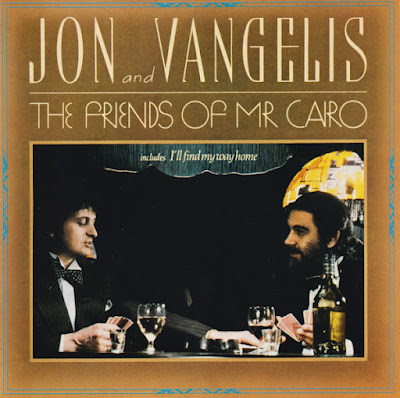
Jon Anderson and Vangelis released several albums over the years. Their merging of musical styles and ideas has always worked quite well from my point of view. While there was one disc before this, Short Stories, this was the one that really got them attention. It was also the first one that came up on my radar. Vangelis is probably best known for movie soundtrack music and “new age” sounds, but if you really look into his past he was also a progressive rock musician in the band Aphrodite’s Child. In fact, at one point he nearly joined Yes. So, it seems like it must have been destiny for these two men to work together. This album is a great one, with only one song that I am not totally hooked on. I’m not sure that I’d say this is my favorite Jon and Vangelis disc (Private Collection is near and dear to my heart, too) but this one will always be right up there. The blending of new age sounds with progressive rock ones is a great marriage. This still holds up remarkably well, even in a totally different millennium. If you haven’t checked out Jon and Vangelis I can think of no better starting point.

Cornelius fits right in with the Beastie Boys' Grand Royal aesthetic. He sees no difference between pop and avant-garde, high culture and lowbrow trash -- he throws it all together, coming up with completely unexpected combinations. The thrill of hearing hip-hop loops morph into sheets of My Bloody Valentine guitar noise, then into sweet Beach Boys harmonies, is what makes his American debut, Fantasma, such a wonder. It's easy to write Cornelius off as a Japanese Beck, particularly since his pop songcraft is as impressive as the busy, multi-layered production, but it's a little patronizing. Cornelius is operating on his own terms, equally influenced by sunny pop ("Chapter 8 -- Seashore and Horizon," boasting harmonies by the Apples in Stereo), garagey hard rock, and kitsch (the cartoonish "Magoo Opening"). He assembles the parts in unpredictable ways -- the hard beats of "Mic Check" suddenly give way to floating acoustics; "Chapter 8" literally has a tape recorder stopping and starting the different parts -- which is why Fantasma is so intoxicating. It is one of those rare records where you can't tell what's going to happen next, and it leaves you hungry for more. [Fantasma was also released with two bonus tracks: "Fantasma Spot" and a demo of "Typewrite Lesson."]
Achingly gorgeous and hauntingly stark, Mark Hollis' self-titled debut picks up where he left off with Talk Talk's Laughing Stock seven years earlier, re-emerging at the nexus point where jazz, ambient, and folk music collide. It's quite possibly the most quiet and intimate record ever made, each song cut to the bone for maximum emotional impact and every note carrying enormous meaning. Hollis paints his music in fine, exquisite strokes, with an uncanny mastery of atmosphere that's frequently devastating. And if anything, his singularly resonant voice has grown even more plaintive with the passage of time, which -- combined with the understated artistry and minimalist beauty of tracks like "The Colour of Spring" and "Watershed" -- makes Mark Hollis a truly unique and indelible listening experience. His obvious understanding of the power of silence aside, one prays he doesn't again wait for the seven-year itch to strike before returning
On their first album for Germany's Marina Records, singer/songwriter David Scott and keyboardist Brian McAlpine offered a welcome antidote to the sound-alike power pop that proliferated in the '90s. Joined by a drummer and string section, the Scottish duo mined many of the same influences (Beatles, Brian Wilson) as their competitors, yet offered melodies and hooks that were reverent but never rip-offs. Cherry Sky is a near-flawless concoction that follows Beach Boys-style choruses with a chorus straight out of the Fab's psychedelic era (complete with "Penny Lane" fire bells). The lovely "Sugar Mountain Babies," meanwhile, owes not a little to McCartney's gentle side, and the jangly "Banana Sandwich" has all the fresh-faced glory of Scottish popsters past, like Aztec Camera or the Bluebells. Other than a couple of lesser tracks, like "Night Breeze," the remainder of the disc is simply high-quality, handsomely performed, and hummable pop you'd be foolish to pass up.


%20Front.jpg)


